Aareon UK has launched Aareon Intelligence, a new approach to artificial intelligence designed specifically for the property sector.
Aareon Intelligence brings together the AI capabilities used across Aareon's software into a single framework for governance, testing, security, and oversight. It helps property organisations deal with growing workloads, increasing regulation and rising customer expectations, without creating more work for their teams.
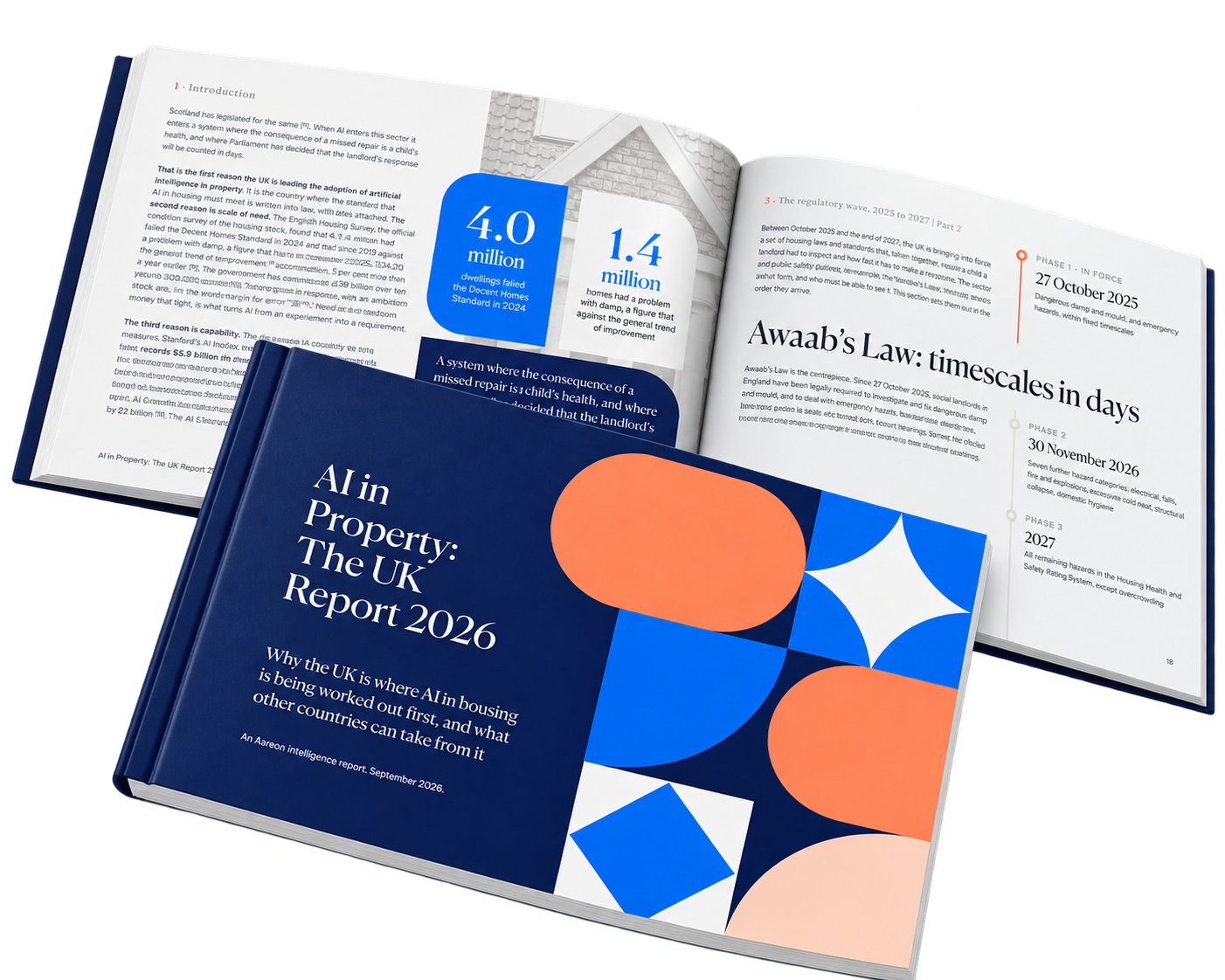
The launch follows the publication of AI in Property: The UK Report 2026, Aareon's new research examining the opportunities and challenges facing organisations adopting artificial intelligence. Drawing on more than 40 sources published during 2025 and 2026, the report found that whilst AI adoption is accelerating across the sector, confidence in how the technology is understood, governed and measured has not kept pace. Read the report.
Nearly half of housing associations surveyed reported using AI in day-to-day operations, yet 87 per cent described their own knowledge of AI as low, according to the National Housing Federation. Across commercial real estate worldwide, 88 per cent of investors and landlords are piloting AI, while only five per cent report achieving all of their objectives.
Those findings highlight a growing challenge for property organisations: not whether AI will be used, but whether it can be trusted within the sector's regulatory and accountability requirements.
Across housing, regulation is increasingly requiring organisations to turn what happens in a property into structured, auditable evidence.
In social housing, Awaab's Law introduced statutory timescales for investigating and addressing serious hazards, with requirements expanding to further hazard categories from 30 November 2026. Similar principles are expected to extend into the private rented sector through the Renters' Rights Act.
The operational burden is also growing across private residential lettings. A new national rental property registration service is due to begin rolling out from December 2026, requiring landlords to maintain prescribed information about themselves, their properties and key safety documentation.
In block management, the Building Safety Act already requires a digital "golden thread" of safety information for higher-risk residential buildings, while forthcoming leasehold reforms are expected to increase transparency around service charges, building condition and planned major works.
"Behind all of these obligations is the same requirement: organisations need reliable information about their homes and buildings, they need to know when action is required, they need evidence of what was done, and they increasingly need to be able to demonstrate it," said Rachael Baig, Managing Director of Aareon UK.
"AI has the potential to remove a significant amount of the administrative burden from that process, from identifying risks and extracting information to prompting action and capturing evidence. But as AI takes on more of that work, the controls around it matter just as much: how it is tested, where accountability sits, and how organisations know it is performing as intended. Aareon Intelligence is the framework we are putting around that use of AI across our products."
Aareon Intelligence has been developed to address those concerns by bringing every AI capability under a common set of standards. At its core are four commitments:
- Every capability is tested before it ships in any Aareon product
- Your data isn't used to train models for anyone else
- Every decision stays with a named person, and the audit trail records who
- Property data and personal data are handled separately, and the software states which it is using
Together, these commitments are designed to help customers benefit from AI while maintaining control, accountability and oversight.
“Housing providers are being asked to evidence what their AI does, to boards, to regulators and to residents,” said Dr Mohammad Alomari, Chief AI Officer at Aareon UK.
“Aareon Intelligence can help teams read certificates, draft consultations, triage repairs and process invoices. People set the boundaries and retain control, with a clear record of actions and approvals.”
Today, more than 450 Aareon customers already use AI-powered capabilities as part of their day-to-day operations. In Aareon Fixflo, AI-powered repairs triage is used by 368 customers, while in HomeMaster, 77 per cent of customers use AI to process invoices and inbound posts. Under Aareon Intelligence, these capabilities are brought together under a common framework that will guide future AI innovation across Aareon's portfolio.
Aareon has published AI in Property: The UK Report 2026 alongside the launch to help the sector understand where AI is being adopted, where value is being realised and what good governance looks like in practice.
The report is available to download for free at www.aareon.co.uk/report
AI in Property: The UK Report 2026 covers the condition of UK housing stock, the regulatory programme from Awaab's Law to the Renters' Rights Act, the UK's position in AI investment and policy, where AI is already in use across planning, local government, social landlords and the private residential lettings sector, and what the UK's approach offers other countries. Every figure is drawn from a source published in 2025 or 2026, listed in full in the appendix with publisher, title, date and scope. Figures relating to Aareon's own products are identified as internal data.
About Aareon UK.
Aareon provides property management software to the UK social housing and private residential markets, including Fixflo, HomeMaster and ActiveH. Aareon UK serves more than 250 housing providers and is part of Aareon Group, which works with 16,000 customers managing 19 million units across Europe.
About Section 20.
Section 20 of the Landlord and Tenant Act 1985 requires a landlord to consult leaseholders before qualifying works where any one leaseholder's contribution would exceed £250. Consultation runs in staged notices carrying rights to observe and to nominate contractors. Where the process is not followed, recovery is capped at £250 per leaseholder unless a tribunal grants dispensation.
Media contact: Gemma Nettle at gemma.nettle@aareon.com